Showing posts with label probate. Show all posts

Saturday, February 15, 2025

Updates on Federal and state limits

 Last last year, the IRS announced the annual updates to certain key figures: 

$13.99 million - the lifetime per-person estate and gift tax exemption equivalent 

$19,000 - annual gift tax exclusion amount, per donor and per donee. If a gift is made that exceeds this limit, a gift tax return needs to be filed, but no gift tax will be payable unless the lifetime limit is exceeded. 

In mid-February, the Michigan Treasurer announced the 2025 figures that apply to several of the provision for estates and trusts under the Estate and Protected Individuals Code. The key items: 

$51,000 - The first annual increase for small estates, collection of funds by affidavit, and money that may be paid to a parent or guardian of a minor without having to name a conservator. 

The full updates, and the amounts that have applied over the past 20+ years, are found here

Sunday, May 5, 2024

New amendments to EPIC

Public Act 1 (2024) made a number of changes to the Estates and Protected Individuals Code (EPIC). These changes were given immediate effect as of February 21, 2024. 

Two of the most significant ones for probate practitioners: 


The expedited estate administration provision of section 3982 and the collection by affidavit (bypassing probate) provision of section 3983 have been expanded to cover estates of $50,000 or less, up from the $27,000 figure that applied in 2023. The figures will continue to be subject to annual adjustments based on cost of living. (Under section 1210, the limit for those who died between January 1 and February 23, 2014 will be the $28,000 certified by the State Treasurer in January.)  


There were several amendments to the Trust Code as well. 


One significant amendment of interest to personal injury practitioners: 


The amount that can be paid under a settlement or payment on a judgment to the parent or custodian of a minor child under section 5102 without having to appoint a conservator is increased from $5,000 per year to $50,000 per year, also annually adjusted. 

Sunday, March 3, 2024

EPIC cost of living adjustments

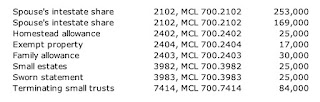
 The state Treasurer has issued the updated cost-of-living adjustments to the several dollar amounts specified in EPIC, as follows: 


The spreadsheet that displays the historical figures is found at https://tech.906law.net 

Tuesday, January 31, 2023

Michigan Treasury Reports

 The reported increases in statutory figures for 2023 are: 

Spouse's intestate share2102, MCL 700.2102273,000
Spouse's intestate share2102, MCL 700.2102182,000
Homestead allowance2402, MCL 700.240227,000
Exempt property2404, MCL 700.240418,000
Family allowance2403, MCL 700.240333,000
Small estates3982, MCL 700.398227,000
Sworn statement3983, MCL 700.398327,000
Terminating small trusts7414, MCL 700.741491,000

As a reminder, the smaller amount under section 2102 applies if none of the decedent's children are also children of the surviving spouse. 

Saturday, February 12, 2022

New figures

 A new year brings updates in dollar limits. The IRS figures first: 

"Annual exclusion" for gifts               $16,000 

Estate/gift tax exemption equivalent  $12,060,000 

Recall that the per-year gift exemption relates to reporting requirements only. If one single person gives another single person $20,000, this exceeds the per-year exclusion, but does not trigger a gift tax liability so long as the exemption equivalent is not exceeded. What it usually requires is the filing of a gift tax report using Form 709. See the IRS instructions for that form. 

For persons dying in 2022, the new figures as certified by the Michigan Department of Treasury are: 


The first two figures differ depending on whether there are children from a previous marriage. 


Friday, February 1, 2019

Updated probate limits

The Michigan Treasurer has certified the following as the amounts for spousal share, statutory allowances, etc. for persons dying in 2019:


Tuesday, November 8, 2016

Appeals from final probate court decisions

MCL 600.308 (part of the Revised Judicature Act, governing courts) and MCL 700.1303 (part of the Estates and Protected Individuals Code, governing procedure in the probate court) have been amended by Public Acts 186 and 287. The two are tie-barred but have different effective dates (9-27-16 and 12-26-16, respectively). 

This changes the former fractured practice, under which some decisions of the probate court were appealed to circuit court and others to the Court of Appeals. Final decisions of the probate court are now appealable by right to the Court of Appeals, as is the case with Circuit Court decisions.

Sunday, January 3, 2016

Michigan estate recovery

The estate recovery program allows the State of Michigan, in some cases, to seek repayment of Medicaid benefits for nursing home care and home health care after the recipient has died.  Mandated by Federal law, estate recovery is essentially a tradeoff for the fact that the recipient's home is not included as a "countable asset" (if its value is under $500,000) when calculations are done to verify that the recipient has assets below the maximum allowed to qualify for Medicaid coverage.

In the majority of cases, for a couple of reasons, the only asset for which the estate recovery claim is asserted is the recipient's home.

Michigan's estate recovery statute, found at MCL 400.112g and 112h, allows for recovery only against "probate assets," that is, property owned by the decedent in his sole name which does not pass to others by operation of law, and for which it is necessary to open an estate in probate court. Property which passes under joint tenancy, for example, is not subject to estate recovery in Michigan. A home owned by husband and wife as tenants by the entirety is likewise not subject to estate recovery. (In other states, such as Wisconsin, jointly-held assets are also subject to the estate recovery laws.)

When the family home is included in the probate estate, there are several exemptions and limitations that are important. The first and most significant is that the home may not be subject to estate recovery if the surviving spouse is residing there. Further, there is a monetary limitation when that exemption does not apply. The home is subject to estate recovery only to the extent to which the price that it can be sold for by the personal representative exceeds
  • "50% of the average price of a home" in the county, plus
  • the costs of estate administration, funeral costs, etc., and
  • all applicable statutory exemptions
The exemptions that are allowed under statute include the homestead allowance, the family allowance, and exempt property. If all three apply, when the decedent leaves a surviving spouse, the total amount can be as high as $64,000, given the current applicable figures.

An unpublished decision of the Michigan Court of Appeals issued in 2015 ruled that the person seeking to apply the 50% average price limitation must take steps to apply for it, and must do so within the time that the department specifies. It will not be automatically available.

Today, eight years after estate recovery was enacted, and five years after it went into effect, there is still some uncertainty as to how "the average price of a home" in a given county can be calculated. There are a couple of online sources that can provide assistance on this issue.

If you have received an estate recovery notice, be sure to consult with an experienced attorney to ensure that the needed steps can be taken.

Wednesday, December 31, 2014

Life and Family

At the Dilbert.com blog, Scott Adams has this to say about his recent experience:
Last week my parents' estate finally got settled. My mother passed first, a few years ago, and as these things so often go, my father slid downhill fast and joined her. When the final distribution checks arrived to the three siblings, I emailed my sister in New York and my brother near Los Angeles to call out something extraordinary: The three of us had navigated the distribution of the estate, and a million decisions, (with my sister in the lead) without a single disagreement. Not one. If you have witnessed sibling behavior during this sort of situation, you know it is unusual to have no disputes. Sometimes you don't know what your parents taught you until you DON'T have a problem. I was deeply impressed with whatever they did to make the three of us so reasonable.
As lawyers, we naturally deal with strife and conflict between family members on a regular basis. It is good to see that these matters can be resolved between family members without grief and misery.

Read the rest of the posting to see how an old chair can become an important part of someone's life.

Happy New Year to all.

Saturday, April 12, 2014

Why use a lawyer?

"Why should I pay a couple hundred dollars to a lawyer when I can get this online form for $35?"

This is a fair question. A few recent examples will help to illustrate the answer.
  • Clients came in with a will prepared by Quicken WillMaker. The first several pages of the will provided detailed instructions for their funeral services, how their bodies are to be handled, etc. I explained to them that this may be useful as their requests to their children, but that none of this is binding on anyone. In Michigan, decisions on the handling of a dead body are made by the next of kin, not by the personal representative of the estate.
  • A quit-claim deed done years ago to transfer a cabin, using a form found at an office supply store, was ineffective because the grantor was a married man at the time, and his wife did not join in the deed. The fact that the man had been single and the only grantee when he acquired the land did not change that outcome.
  • In a recent reported case coming out of Florida, Ann Aldrich created a will using an "EZ Will Form" in 2004. The form did not include a residuary clause, a provision directing what should happen with the remainder of the individual's property after specific bequests are made. As a result, after her death, her two nieces received a substantial sum of money, even though the rest of the will showed that her brother was her intended beneficiary.
The answer to the question: Yes, you can do it for $35, but you can do it right for a little more. A simple quit-claim deed done in our office may cost $100, for example. When your transaction involves property worth several thousands of dollars, spending what it takes to do it right makes much more sense.

Saturday, February 22, 2014

New ruling in ongoing Rosa Parks Trust dispute

Another chapter, perhaps the last chapter, in the ongoing disputes regarding the Rosa Parks Trust has now been written. The Michigan Court of Appeals issued its unpublished decision in the case entitled In re Rosa Louise Parks Trust on February 20, 2014. This is the third time that the parties to the dispute have been before the appellate courts. The parties to this appeal included Elaine Steele and the Rosa and Raymond Parks Institute for Self-Development, founded by Parks and Steele in 1987.

In the earlier decisions, the Supreme Court had upheld and ordered enforcement of a settlement agreement that the parties had previously negotiated and consummated, in particular the reinstatement of Elaine Steele and former judge Adam Shakoor as trustees and co-personal representatives of the estate, as nominated in the trust agreement. There had also been litigation over attorneys fees exceeding $120,000 incurred by a law firm.

After remand on the earlier decisions, the attorney for Steele and the Institute, not named in the opinion but identified in a Detroit Free Press article as Steven G. Cohen of Farmington Hills, Michigan, filed a petition naming the probate judge as a respondent, and charging that he had engaged in a conspiracy with the attorneys for other parties to disregard the trust's nomination of Steele and Shakoor and to replace them with "long-term probate court cronies." He then petitioned the probate judge to order his own disqualification based on claims that he was not impartial and that he was now a party to the proceedings. Other petitions followed.

In May 2012, the judge advised that he was taking the disqualification motion under advisement, and postponed the other petitions pending a decision on that motion. Thereafter, Cohen filed a proposed default and default judgment, submitted interrogatories (written questions) to the judge, and served him with a subpoena for deposition.

The probate judge ultimately denied the disqualification motion, dismissed the petition alleging conspiracy, and made rulings on other petitions.

The decision by the Court of Appeals includes the following rulings:
  • The dismissal of the conspiracy petition was affirmed. The probate court had no jurisdiction to hear the conspiracy claim, since the issues in question had previously been ruled upon by the court, with no appeal filed. 
  • The challenging parties had advanced no evidence to support claims of conflict of interest or inappropriate conduct which would warrant disqualification. Naming a judge as a party and then seeking his disqualification would open every litigated case to manipulation by any party, if permitted. 
  • The court still had authority to make rulings on issues other than those directed by the previous appellate decisions reversing and remanding the case with instructions to enter one particular order. 
  • The issues raised regarding the accountings filed by the fiduciaries were unsupported by legal arguments and thus were not preserved for appeal. 
In addition, on its own initiative, the Court of Appeals made a finding and ruling that Cohen's actions in seeking disqualification of the probate judge and pursuing the present appeal were entirely improper and that he had engaged in a vexatious appeal. The case was remanded for consideration of the proper sanction, which would involve the assessment of costs, attorneys fees, and punitive damages, and whether that sanction should be imposed on the client, the attorney, or both.

Thursday, January 2, 2014

Lion Cub deeds - myth vs. reality

The Lion Cub deed is an elusive creature. It is fleetingly mentioned on the web sites of some Michigan estate planning and real estate attorneys, but there is very little detail provided at any of them.

The idea, it appears, is to structure real estate ownership so that one party (the "lion," typically the parent who originally owns the land) owns a high majority share of real estate, 90% to even 99%, while the small conveyed percentage passes to the other (the "cub," typically the child or children of the original owner). This conveyance is an event that would generate a divestment penalty if done within the 60-month lookback period that applies for Medicaid coverage for nursing home expenses, but the fact that only a small fraction of ownership is divested means that the disqualification period would be quite short. If the land in question is worth $400,000, for example, conveying a 1% interest would result in a divestment penalty of $4,000, well under the cost of one month of nursing home care.

The problem is that these conveyances may not be made in a manner which is effective under Michigan law. The strategy does not work if done using joint tenancy as the ownership vehicle. The "lion" and the "cub" must take ownership as tenants in common, not as joint tenants, if they want to create a proportional ownership. Yet we have seen promotional materials in attorneys' offices which say that the deed will be done to convey the land "in joint tenancy" with a 90-10% or 99-1% split. The promise is that the client can get the best of both worlds - probate avoidance and avoidance of Medicaid divestment penalties.

The concept described simply does not exist under Michigan real estate law. There is no such thing as a joint tenancy with an assigned ownership percentage. The interests of each co-owner must be equal under a joint tenancy. Further, although clients may think otherwise, two people who own land in joint tenancy do not each own 50%. Four joint owners do not each own 25%. (The fact that taxing authorities or the agency administering the Medicaid program might treat it that way does not change this rule.) Instead, each owns an equal and undivided interest in the entire parcel of land, with a right of survivorship among all co-owners. As each joint owner dies, his or her interest in the parcel ends. The survivor among all joint owners emerges as the full owner of the entire parcel.

It is hard to understand what benefit a landowner would derive from conveying a tiny percentage of ownership, as a tenant in common, to one or more of the landowner's children. Joint ownership of real estate is a method that is widely used to avoid having the land pass by will or intestacy in probate court - see our earlier posting entitled "Reasons Not to Do It" - but it is entirely inconsistent with the idea of fractional or proportional ownership of real estate. Conveying a parcel of land to a parent and child as tenants in common, with a significantly disproportional ownership balance, may be effective to avoid Medicaid penalties when nursing home care is needed, but it does nothing to avoid probate. The 90% or 99% interest of the parent, owned by him or her as a tenant in common with the child, would still have to be assigned under a will or pass by intestacy, and this would require a filing in probate court. Depending on how many children are involved in the two transactions, the end result could be quite complex.

Each of these approaches may work to achieve a desired result, and each should be explained by counsel. But confusing the two is likely to lead to unexpected and unplanned consequences.

Wednesday, October 23, 2013

How to handle a death

An Arizona law firm has posted a useful reference guide called What to do when someone dies. The tasks are listed in stages - what should be done immediately, within 24 hours, within a couple of weeks, etc.

Saturday, January 14, 2012

Transparency, long ago

This post from Ann Althouse's weblog, intended to make a humorous point, depicts a practice from long ago: publishing the last will and testament of a recently deceased person on the front page of the local hometown newspaper. Once filed with the probate court, it is a public record, after all.

Friday, November 4, 2011

Reasons not to do it

Many people believe that putting the family home or other real estate in joint tenancy with their children is the best way to provide for post-death succession, without the need for involvement of the probate court. There are several complications which suggest the need to act cautiously.
  1. Once a parent puts a child on the title of the home as a joint owner, the child is from that point forward a full joint owner. The parent cannot later decide to sell the house, rent it out, or seek a mortgage or home equity line from a bank or credit union, without the agreement of the child.
  2. An older parent who is facing the prospect of admission to a nursing home in the next few years will find that the act of adding a child as joint owner of the home will be regarded by the Department of Human Services as a partial divestment of property, and this will result in a period of ineligibility for Medicaid benefits.
  3. Depending on the circumstances, the creation of a new joint tenancy may result in the inadvertent “uncapping” of the taxable value of the real estate, resulting in higher property taxes. 
  4. If the child who is added as a joint owner later has a judgment entered against him by a court, the judgment will have to be paid if the house is to be sold - even though the parents were the ones who paid for the house. 
Balanced against these, the only reason to add one or more joint tenants on a home is to avoid having to have the home subject to probate on the death of the current owner. For many clients, the reasons not to do it will outweigh this one consideration.

Under the General Property Tax Act, there is a limit (“cap”) on increases to property tax assessments while the property remains under the same ownership. In most cases, a transfer in ownership removes that limit and allows for “uncapping” the assessment, often leading to a higher property tax liability. The law provides for a number of exceptions.

The March 2011 decision of the Michigan Supreme Court in Klooster v. City of Charlevoix changed the general understanding of how and when the creation, modification, or termination of a joint tenancy will uncap assessed value.

Under the newly clarified rule explained in that case, you will not uncap the taxable value of the property by adding one or more new joint tenants if
  • you or your spouse were an owner immediately after the most recent uncapping event and
  • you have remained as an owner continuously since then.
If, on the other hand, someone else (other than a spouse) added you as a joint tenant, and then died leaving you as the surviving owner, adding a new joint tenant will uncap the taxable value.

Update 1-24-15: John Payne's article The Curious Case of the Persistent Step-Up deconstructs a myth that misleads many lawyers. So long as the property is included in the decedent's estate, the surviving joint will still receive the step-up in basis. Thus capital gains considerations should not affect the decision on whether to use this probate avoidance technique. 

Wednesday, September 21, 2011

Small estates

After the filing of a petition in probate court, a personal representative is appointed and given the task of marshaling the assets of the estate, providing for allowances to family, identifying and paying creditors, and distributing estate assets to beneficiaries. The term "estate" simply means the assets and property that belonged to the decedent that did not pass to others by law.

There are simplified administration processes and non-probate alternatives for those estates with very limited assets.

Small estate administration - Under section 3982 of the Estates and Protected Individuals Code (EPIC), if the total assets are less than $21,000 (current amount, annually adjusted for inflation) after payment of funeral and burial expenses, a family member may file a Petition and Order for Assignment and may distribute the funds to the spouse or surviving heirs. No estate is opened and there is no administration, so this method cannot be used to follow the directions under a will. If the recipient is a spouse or minor child, no creditor may assert a claim. For other recipients, the funds are subject to claims of the decedent's creditors for 63 days after the order is entered.

Summary administration - Under section 3987, if the total of the homestead allowance, family allowance, and exempt property allowance, plus funeral costs and the costs of the last illness, exceeds the amount of the decedent's probate assets, distribution may be done immediately after the estate is opened. The personal representative does not have to give notice to creditors. The estate may be distributed immediately and a closing statement filed with the court.

The following do not require any probate court filing.

Sworn statement - If no probate proceedings have been filed because of limited assets, the person who is the successor of the deceased may submit a sworn statement to establish that no probate proceedings have been filed, that the total value of the estate is less than $20,000, that the assets do not include real estate, that 28 days have elapsed since the death, and the names and addresses of all persons entitled to the property. This statement may be submitted to any person having custody of the decedent's personal property or who is "indebted" to him, including a bank or other financial institution. On receipt of the sworn statement and the death certificate, the custodian must deliver the property to the successor. No probate proceedings are required. The custodian may not refuse to follow this procedure. Section 3983 of EPIC.

Motor vehicles and boats - If there is no probate filing, the Secretary of State will transfer the title of any motor vehicle or boat registered to the decedent to his family. This title transfer process is subject to limits of
  • $60,000 in value for all motor vehicles, MCL 257.236(2)
  • $100,000 for all boats and watercraft, MCL 324.80312(3)
Personal effects - A hospital, nursing home, or law enforcement agency is authorized to release a decedent's clothing and property worth up to $500 to a spouse or other family member on a showing that no probate proceedings have been commenced. Section 3981 of EPIC. 

Decedent's pay - The final wages or salary payable to a decedent may be paid to his or her spouse, children, or other surviving family under MCL 408.480. 

Wednesday, August 31, 2011

Family fight in a country song

Gerry Beyer of the Law Professors Blog Network posts the lyrics to a song from Hell on Heels, by the Pistol Annies, called Family Feud. The song describes a family fighting over the possessions of their recently deceased mother. A snippet:

I'm watching it all go down in shame
Wish the whole house would go up in flames
Who gives a damn about a cedar chest
When we just laid her soul to rest

Wednesday, July 20, 2011

Debts of the decedent

At Bankrate.com, Steve Bucci answers a "debt advisor" question from a reader who had accumulated some $35,000 of gambling debts. The reader's father took out $35,000 in "unsecured loans" - i.e., cash advances on credit cards - and had begun paying off those advances, apparently with money from the son. The father then died unexpectedly. The reader's mother knew nothing about the loan arrangement.

The father left no assets and no will. The reader's concern is that the credit card companies would try to collect on the debts from his mother, who does have assets. He wonders if he should "continue to pay on these debts". This suggests that it was the reader, not the father, who had been making the payments on the credit card accounts.

Bucci's answer includes these points:
  • If the parents are residents of a community property state - Arizona, California, Idaho, Louisiana, Nevada, New Mexico, Texas, Washington or Wisconsin - then the mother would have a responsibility to follow up on these debts.
  • If they live elsewhere, then she has no legal responsibility for the debt.
  • She may still feel a moral obligation to make good on the debt.
  • She needs to know about the arrangement, because she is likely to be contacted by the creditors, and is likely to be give false information suggesting that she has a legal obligation to continue to pay on the accounts.
  • Both of them should consult with counsel regarding their rights and obligations.
He recommends that "the executor of the estate" make contact with the creditors, explain that the debtor has died, and provide a copy of the death certificate. He overlooks the fact that the father died with no will and no assets. There will not be an estate or an executor (in Michigan, a "personal representative"). But the advice is sound. Any family member can make the contact and provide the certificate.

When a debtor dies, the following applies in Michigan:
  • Any debt which is secured (car loans, mortgages) must still be repaid. If it is not repaid, the property securing the debt can be seized and sold.
  • Any debt which is unsecured must be repaid from the probate assets of the deceased, or from his trust assets.
  • If there are no such assets, then the creditor will not be able to collect.
"Probate assets" refers to any property that was owned by the debtor, in his own name, without any other person as co-owner. If the debtor dies without any probate assets, or without assets passing to others under a trust, then the creditors are out of luck. The death benefits of life insurance policies, money passing under an IRA or other form of pension to a designated beneficiary, or property passing by virtue of joint ownership are not subject to the claims of the creditors of the decedent. The sole possible exception would arise if it can be shown that the decedent took steps to defraud his creditors by moving personal assets into some form of ownership that would not have to respond to his actual and known debts.

More:

Effect of the OBBB

The per-person exemption equivalent for estate and gift taxes has been increased to $15 million, and will continue to be indexed. That is an...